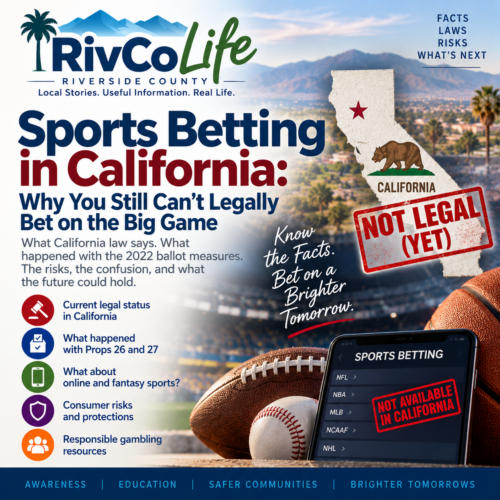
Turn on almost any major sporting event and you’re likely to see them.
Advertisements encouraging viewers to bet on the game. Promotions offering bonus bets. Television commentators discussing betting lines and point spreads. Entire segments devoted to who is favored and by how much.
It can leave Californians with a reasonable question:
Can I legally bet on sports here?
For traditional sports betting, the answer remains no.
Despite California’s enormous professional-sports market and its extensive gambling industry, traditional sports wagering has not been legalized in the state.
And California voters have already been asked whether they wanted to change that.
They said no.
What Happened in 2022?
California voters faced two competing sports-betting measures in November 2022.
Proposition 26 would have permitted in-person sports wagering at tribal casinos and four licensed horse-racing tracks. It also would have allowed tribal casinos to offer roulette and dice games under qualifying gaming compacts.
Proposition 27 went considerably further. It would have legalized online and mobile sports wagering for adults 21 and older through qualifying tribes and affiliated gaming companies.
Neither passed.
The result left California’s prohibition on traditional sports betting in place.
That means the sportsbook app you may see advertised during an NFL or NBA game cannot simply accept a conventional sports wager from someone physically located in California.
Why Is California Different?
The answer involves more than whether lawmakers like or dislike gambling.
California already permits several forms of gambling, including the California Lottery, pari-mutuel wagering on horse racing, tribal gaming and certain games offered through licensed cardrooms.
Tribal gaming is particularly important to the sports-betting debate.
Federally recognized Native American tribes operate casinos under a combination of federal law, California law and tribal-state gaming compacts. Those tribes have become significant participants in discussions over how—and by whom—sports wagering could eventually be offered.
Commercial gaming companies also have an enormous financial interest in gaining access to California.
With nearly 40 million residents and major franchises in the NFL, NBA, MLB, NHL, MLS and other sports, California would represent a massive potential sports-wagering market.
But potential profits don’t change the law.
California voters would still need to approve the kind of constitutional changes necessary for many proposed forms of sports wagering.
What About Daily Fantasy Sports?
This is where things become even more complicated.
Daily fantasy sports have long occupied a confusing position for California consumers.
In July 2025, the California Attorney General’s Office issued a formal legal opinion concluding that California law prohibits the operation of daily fantasy sports games involving players physically located within the state, regardless of where the company operating the games or its technology is located.
That opinion did not create a new law. The Attorney General specifically explained that the office was interpreting existing California law and that changing the law is a job for the Legislature and California voters.
The distinction matters because fantasy-sports products can sometimes look and feel very similar to sports betting even when companies describe them differently.
Consumers should not assume that a website or app is legal in California simply because it is available for download or accessible through a web browser.
But I See Sportsbook Advertisements All the Time
That’s largely because sports advertising is national.
A television network broadcasting a football game into Riverside County may be showing the same sportsbook commercial to viewers in states where online sports betting is legal.
The advertisement doesn’t mean the service is authorized to accept sports wagers from California residents.
Legal online sportsbooks generally use geolocation technology to determine whether a customer is physically located within a jurisdiction where wagering is permitted.
Simply having an account with a sportsbook doesn’t make sports wagering legal while you’re physically in California.
What About Offshore Betting Websites?
The Internet makes it possible to find gambling websites operating outside the United States that claim to accept bets from Californians.
That doesn’t make them California-regulated sportsbooks.
And that’s an important distinction for consumers.
A regulated gambling market can provide rules governing licensing, consumer protection, disputes, responsible-gambling requirements and the handling of customer funds.
Sending money to an offshore operator can leave a customer without those same California regulatory protections if something goes wrong.
A flashy website is not the same thing as a California gambling license.
Could Sports Betting Eventually Become Legal?
Absolutely.
The failure of Propositions 26 and 27 didn’t permanently settle the question.
Future legislation and ballot initiatives can bring sports wagering before Californians again, and various proposals have continued to surface since the 2022 election.
But any future proposal will likely involve some of the same difficult questions:
Who gets to operate sports betting?
Will it be limited to tribal gaming operations?
Will commercial sportsbook companies participate?
Will betting be available only in person or through phones and computers?
How will gambling revenue be taxed or distributed?
What protections will exist for problem gamblers?
And perhaps most importantly, what arrangement will California’s tribes, lawmakers, gambling interests and voters actually accept?
Those questions involve billions of potential dollars.
They also involve legitimate concerns about gambling addiction and the ease with which a smartphone can turn gambling into a 24-hour activity.
Sports Betting Isn’t Free Money
If sports wagering eventually becomes legal in California, there’s another fact worth remembering.
Sportsbooks are businesses.
They aren’t offering wagers because they expect customers, collectively, to beat them.
The point spreads, odds and other mechanisms used by sportsbooks are designed so the operator maintains an advantage over time.
Someone can certainly win an individual bet. Someone can have a winning weekend—or even a remarkable winning streak.
But betting should never be viewed as an investment strategy, a reliable source of income or a way to solve financial problems.
And never gamble with money needed for rent, groceries, utilities, medication or other necessities.
When Gambling Stops Being Entertainment
Most people who gamble don’t develop a gambling disorder.
For some, however, gambling can become destructive.
Warning signs can include chasing losses, gambling with increasingly large amounts of money, hiding gambling activity from family members, borrowing money to gamble, missing financial obligations, or repeatedly trying and failing to stop.
California provides free, confidential help through the California Problem Gambling Helpline at 1-800-GAMBLER (1-800-426-2537), available 24 hours a day.
As sports betting continues expanding throughout much of the country, the debate over whether California should join those states isn’t going away.
Maybe voters will eventually say yes.
Maybe they’ll say no again.
But for now, despite all those sportsbook commercials appearing between touchdowns, home runs and three-pointers, the situation remains fairly straightforward:
Traditional sports betting is still not legal in California.
And an advertisement on television doesn’t change that.
This article is provided for general informational purposes and should not be considered legal or financial advice. Gambling laws and regulations can change. Readers should consult current California law and appropriate state agencies when determining whether a particular gambling activity is lawful.
RivCo Life
Local Stories. Useful Information. Real Life.